

There’s a problem that needs a fast solution. A new system, an extra feature, or an entirely new product. Many organizations jump straight into solution mode and start building right away. The result is that a lot of time and budget goes into something that doesn’t actually solve the problem.
Design Thinking flips this around. Instead of starting with the problem, you start with the people who experience it. Why do they run into this problem, and what do they need from a solution? In this blog, we explain what Design Thinking is, what phases the method includes, and how to apply it in an organization with multiple departments and stakeholders.
| Key takeaways at a glance: 1. Design Thinking is a human-centered, iterative method for solving complex problems. 2. The method has five phases: empathize, define, ideate, prototype, and test. You don’t work through them like a checklist, but repeat them until the innovation works. 3. Developing prototypes early and testing them with real users helps you avoid costly mistakes later in the process. 4. In large organizations, Design Thinking creates a shared understanding of a problem. This builds support and keeps different departments aligned. 5. A design sprint is a condensed form of Design Thinking. In a short time, you go from challenge to tested prototype. |
In this blog:
- What is Design Thinking?
- The 5 phases of Design Thinking
- Why does Design Thinking work?
- How to apply Design Thinking in large organizations
- The design sprint: Design Thinking in a short time
- A Design Thinking example in practice
- How we apply Design Thinking
What is Design Thinking?
Design Thinking is a systematic, human-centered way of solving complex problems. The needs of the user come first, rather than the technology, the policy, or the assumptions within the organization.
Design Thinking is an iterative process. This means you keep learning from users and adapting the solution accordingly. That’s why there’s no fixed protocol for the method. It’s above all a different mindset, one where you first want to truly understand the problem before you start working on a solution.
The 5 phases of Design Thinking
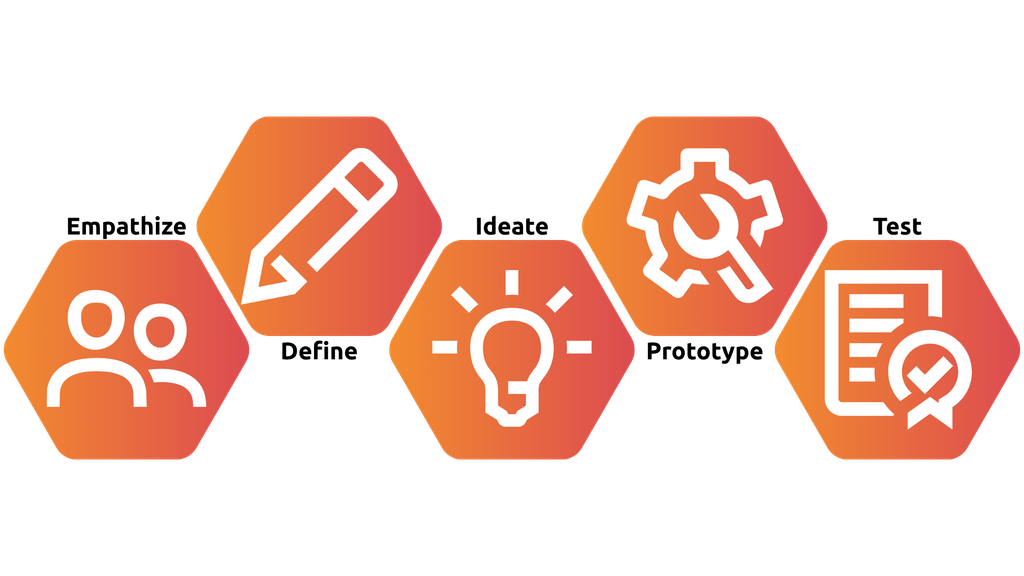
Design Thinking consists of 5 phases: empathize, define, ideate, prototype, and test. Below, we explain what happens in each phase.
1. Empathize: put yourself in the user’s shoes
Empathize is about truly getting to know your target group. What challenges do users run into? What frame of reference do they reason from? And what do they expect from a solution? The answers to these questions give you the insights to lay a solid foundation and find the core of the problem. You can do this through interviews, but it’s more effective to observe users in their own environment.
For example, a medical device manufacturer wants to develop a new infusion pump. The team spends a day shadowing nurses on a hospital ward. They notice that the pump is often set up in a hurry, while wearing gloves. The buttons turn out to be too small for this. Ideally, they would be adjusted. This wouldn’t have come up in an interview.
2. Define: determine the real problem
In the second phase, you bring together all the insights from the first phase. What is the real problem? Often, it turns out to be a different problem than you expected. There’s a question behind the question.
A useful way to get to the bottom of it is to map out the route a user follows. You lay out step by step what a user does, from start to finish. At each step, you note where the user runs into trouble. This shows you exactly where things go wrong. Then you summarize the problem in a single question that starts with “How can we…”. That question puts the user at the center and leaves room for multiple solutions.
Take a construction company where site managers ask for an app to report faster. The team maps out their working day. It turns out that the reporting itself takes very little time. Most of the time goes into searching for drawings, schedules, and agreements that are all stored in different places. The question then becomes: “How can we make sure site managers can find all project information in one place?” That calls for a completely different solution than a reporting app.
3. Ideate: come up with as many solutions as possible
Now that the problem is clear, you can start looking for solutions. In the ideate phase, you come up with as many ideas as possible. No single idea is right or wrong at this stage. The more directions you explore, the greater the chance of landing on a good solution.
Coming up with as many solutions as possible works best with a multidisciplinary team. An engineer simply looks at a problem differently than a designer does. Let everyone sketch ideas from their own expertise first, before you discuss them together. That way, every idea gets an equal chance. Then you choose together the ideas that best fit the user.
You can see how this works with a manufacturer of security systems that wants to speed up access control at large events. An engineer, a designer, and an experienced security guard come up with more than thirty ideas together. These include a wristband with a light and a gate that gives a signal by itself. The security guard knows from experience what works in a crowd. Thanks to his knowledge and experience, three ideas remain in the end.
Also interesting: The multidisciplinary approach of Beeliners
4. Prototype: make it tangible
In the prototype phase, the best ideas are made tangible. This doesn’t have to be a perfect product or system yet. A sketch, a cardboard model, a 3D design, or a simple clickable app design is often enough. The goal is to learn, not to present.
The simpler the prototype, the faster you have something in your hands and the lower your costs. This lets you try out several ideas before you invest seriously in one.
A machine builder that wants to use AI to detect deviations in products on the production line doesn’t build a complete system right away. The team hangs a standard camera above the production line and connects it to a laptop running a simple recognition model. Within a few days, it’s clear whether the camera detects the deviation well enough. Only then do they invest in the final hardware.
5. Test: learn from real users
In the test phase, you put the prototype in front of real users. You don’t tell them how it works, but watch how they use it. Where do they hesitate? Where do they get stuck? And what comes naturally? Afterwards, you ask a few short questions. This is how you find out whether the solution really solves the problem.
You use the feedback you’ve gathered to adjust the prototype, then test it again. You repeat this iterative process until the solution works the way you envisioned.
A manufacturer of heating systems presents a new control panel to twenty households. Most users first look for a dial to set the temperature, while the panel only has a touchscreen. Based on this test, the team adds a dial and tests again. In the second round, all users find the right setting without help.
Not a checklist, but a cycle
The phases above aren’t a step by step plan that you work through in one go. A test can produce new insights that send you back to the define phase. A prototype can also teach you that you don’t know your user well enough yet. You keep moving between the phases until the solution works.
Why does Design Thinking work?
Design Thinking works because it takes empathy as its starting point. You don’t come up with innovations based on policy or assumptions. Instead, you start with the person behind the problem and keep coming back to them. As a result, the final innovation is not only more creative, but also more sustainable and relevant.
But Design Thinking has even more benefits:
- Lower risk: You test ideas early and cheaply. Mistakes are caught at an early stage, not only once the product is already in production.
- Faster results: A prototype brings clarity faster than a long specification or a discussion on paper.
- Solutions that fit your target group: You develop a solution that users need, not what the organization thinks they need.
- A balance between people, technology, and organization: A good solution is desirable for the user, technically feasible, and financially viable. Design Thinking keeps these three in balance.
You can feel the effect of Design Thinking within the organization too, because the way of working changes. Teams ask sharper questions and take the time to truly understand the problem. Users and colleagues get involved in the process, and teams that used to get stuck regain energy and momentum.
How to apply Design Thinking in large organizations
Innovating in a large organization quickly gets complicated. The willingness is there, but every department has its own goals and interests. Teams are spread across the country, decision making takes a long time, budgets are fixed, and change quickly runs into resistance. Design Thinking also requires letting go of control, linear plans, and familiar structures. That can be daunting and sometimes even frustrating.
That’s exactly where Design Thinking helps. Not only to arrive at a solution, but also to create clarity and support. In a large organization, you can approach it as follows:
- Put together a multidisciplinary core team: Bring people from different departments together, such as R&D, engineering, marketing, sales, service, and production. Each department contributes its own knowledge. People who are involved in a new innovation from the start and help shape it will also back the outcome later on.
- Make the problem your own, together: Have the core team interview and observe users together. This shifts discussions from “What does my department want?” to “What does the user need?” A shared problem definition is the foundation for support.
- Let prototypes lead the conversation: A prototype says more than a presentation. Everyone can see it, and it makes the idea more tangible. Test results from users replace opinions with facts, which makes decisions easier, including for management.
- Work in short sprints with fixed decision points: Invest step by step instead of budgeting everything upfront. Every sprint delivers insights, and based on those you can decide whether to continue, adjust course, or stop altogether. This fits better with internal budgets and lowers the risk.
- Start small: Begin with one specific challenge. A successful project shows what the Design Thinking method can deliver, which makes the next one easier.
The design sprint: Design Thinking in a short time
A design sprint is a compact way to apply Design Thinking. The best-known format runs for five days: you map out the problem, sketch solutions, choose the strongest direction, build a prototype, and test it with users. For organizations where projects tend to drag on, it’s a way to get tangible results in a short time.
A Design Thinking example in practice
An international heat pump manufacturer had been receiving a lot of complaints about malfunctions in recent months. Every department had its own solution in mind: R&D wanted to improve the software, marketing wanted a new app, and service wanted more technicians. To find the right solution, a core team was put together with colleagues from different departments.
The core team decided to start by talking to installers and end users in several countries. This showed that many malfunctions were caused by incorrect settings during installation. Installers were working under time pressure, and the manual was unclear.
The new problem statement became: “How can we help installers set up a heat pump correctly from the start?” The team then came up with several solutions together and ultimately chose a step-by-step installation guide built into the control panel. Within a short time, a prototype was ready for installers to test. A few steps that turned out to be unclear were then adjusted.
The end result was a solution that tackles the real problem. All departments recognized the problem because they had seen it for themselves, so the budget for further development was quickly secured.
How we apply Design Thinking
At Beeliners, you’ll find Design Thinking in every project. Together with your team, we start with the user and uncover the real problem. During design sprints, we sit down with the different departments of your organization. That way, everyone shares the same picture from the start, and decisions are backed by the whole organization.
Is the solution you need already clear? Then we build a first prototype as quickly as possible. We process the feedback and keep going until the final innovation is ready. You stay in control at all times, and we work as an extension of your team.
Want to know more about how we apply Design Thinking and how we can speed up your innovation process? Get in touch with us, no strings attached.
Frequently asked questions
Design Thinking is a human-centered method for solving complex problems. You start with the user’s needs, define the real problem, come up with solutions, and test them with prototypes. You repeat this process until the solution works.
The foundations of Design Thinking date back to the 1960s, when designers and scientists began studying how designers think and work. The aim was to capture that approach as a method that could also be used outside the field of design. The model has continued to evolve ever since. The five-phase model covered in this blog is the one most widely used today, and it became well known through Stanford University.
The five steps are empathize (understand the user), define (pinpoint the problem), ideate (generate ideas), prototype (make it tangible), and test (try it with users). You don’t work through them in a straight line, but move back and forth between the phases.
Commonly used techniques include interviews and observing users in their own environment, mapping out the user’s journey step by step, and summarizing the problem in a “How can we…” question. After that come brainstorming and sketching in a multidisciplinary team, simple prototypes, and testing with real users.
You reduce risk by testing early, get to results faster, and develop solutions that fit the user’s needs. In larger organizations, it also creates clarity and support across departments.
Start by interviewing and observing users. Frame the problem as a “How can we…” question. Turn your ideas into a clickable prototype and test it with real users before you start building.
Design Thinking is used in the Netherlands by startups, SMEs, and multinationals, as well as by government bodies and healthcare organizations. You’ll see it across a wide range of sectors, from energy and healthcare to construction and industry.
Also interesting
-

Business case for innovation
Within larger organizations, innovation projects stall more often than you’d think. They start with a great idea and plenty of energy, but as soon as the risks take center stage, the project loses momentum. As a result, the team loses direction and motivation. Because the outcome of innovation is… Read More
-

Product innovation vs. product optimization: when should you invest in innovation?
Anyone managing a mature product portfolio regularly faces the same choice: do we keep improving the current product step by step, or invest in an entirely new one? For SMEs and multinationals, this is a key portfolio question. Do you develop an existing platform further to maintain short-term… Read More
-

The multidisciplinary approach of Beeliners
Many product development trajectories experience delays because disciplines only start communicating with each other at a late stage. The hardware works, but does not fit the design. The software does what it needs to do, but the controls do not feel intuitive. Or technical limitations arise that could have… Read More