

Imagine: a world in which we no longer produce waste. Where products are reused endlessly and companies smartly profit from sustainable models. It sounds futuristic, but the reality is that we are moving towards that faster than ever.
The circular economy is not just a trend, but a necessity and an opportunity for entrepreneurs who want to lead the way. In this blog, we tell you about the importance of a circular economy and which steps your organization can take to work circularly.
In this blog you’ll read:
- What is circularity?
- What benefits does circular entrepreneurship offer?
- 10 strategies for working circularly
- What steps can I take myself to work circularly?
What is circularity?
In a circular economy, everything revolves around closing loops. Products, parts, and materials do not lose their value, but are reused, repaired, or redesigned. It is the opposite of the linear economy (“take, make, waste”), in which raw materials are used and then thrown away.
What benefits does circular entrepreneurship offer?
More and more organizations are discovering that circularity is more than a sustainability label: it is a strategy that links financial benefits to social impact. The reasons to make the switch are diverse:
- Financial benefit: Circular entrepreneurship can directly result in cost savings. Think of more efficient use of raw materials, less waste production, and taking advantage of subsidies. Products that last longer also reduce replacement costs.
- Stronger market position: Consumers and stakeholders increasingly expect companies to operate in a socially responsible way. Companies that work circularly gain trust and build customer loyalty. A positive impact on your market position is then often a logical result.
- Laws and regulations: The government is continuously tightening requirements. The Netherlands has the ambition to be fully circular by 2050. The EU is also focusing on eco design and efficient material use (Eco Design Guide, NEN guidelines).
- Innovation: Circularity stimulates new business models. The product as a service model is a clear example: revenue shifts from sales to long term customer relationships.
- Future proofness: By working circularly, you reduce your dependency on scarce raw materials and actively contribute to counteracting climate change. Moreover, you are better prepared for economic uncertainties.
10 strategies for working circularly
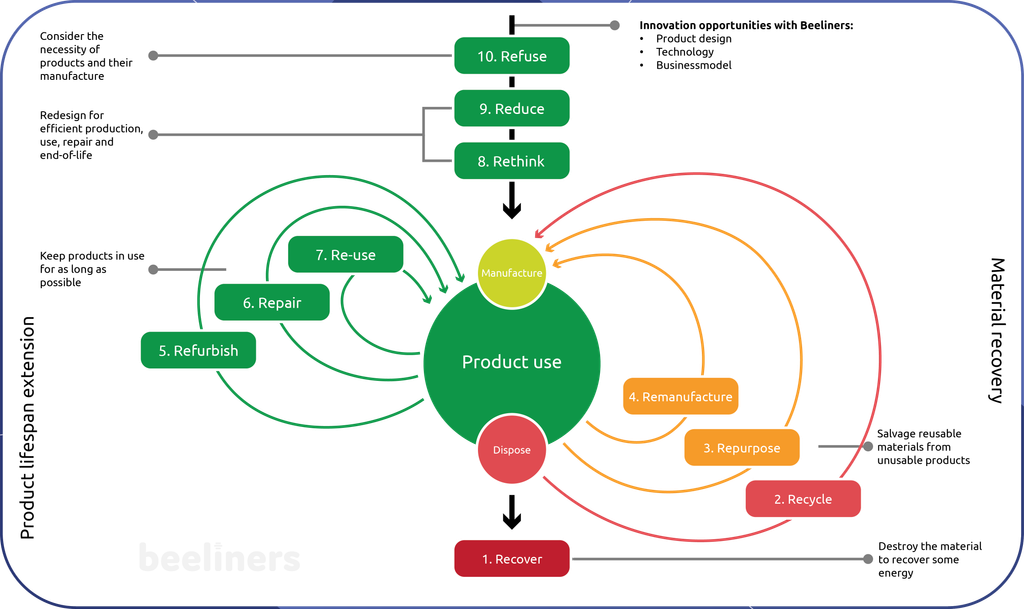
For many companies, circularity is still a very broad concept. The 10R model gives more insight into which concrete choices can be made. This model shows that there is not one way to work circularly, but that there is a whole range of strategies. From completely avoiding that something is made to recycling materials. The higher something is on the list, the greater the circular impact usually is.
The 10 strategies are:
- Refuse: Prevent unnecessary consumption and choose consciously. Think of refusing products that are poorly designed or not sustainably produced.
- Rethink: Design smarter and use products more efficiently, for example by building in repairability, sharing platforms, or multifunctional use.
- Reduce: Limit the use of raw materials through lighter, more economical, or more sustainable designs.
- Reuse: Give products a second life directly, for example through secondhand sales or reuse of products or parts.
- Repair: Extend the lifespan of products by repairing them.
- Refurbish: Bring old products back to a usable state, often with a more modern look or functionality.
- Remanufacture: Use parts of old products again to use as new, for example in the automotive industry.
- Repurpose: Use materials or parts for a different purpose than they were originally intended for.
- Recycle: Process material again into raw materials for new products.
- Recover: Recover energy or raw materials from waste that can no longer be used, for example through incineration with energy recovery.
What makes this model powerful is that it invites companies and organizations to start higher on the ladder. Recycling is useful, but only as a last option. Real circularity starts with reducing, rethinking, and using more efficiently.
The 10R model thus offers not only a list of possibilities, but also a mindset shift: away from linear thinking, towards an economy in which value is retained.
What steps can I take myself to work circularly?
Now that you know why circular entrepreneurship is valuable, the most important question follows: how do you approach it concretely? Below are seven practical steps that you can apply directly within your organization:
- Think in services, not in products: The product as a service model ensures that you remain the owner and can reuse materials. Customers pay for use, you retain control.
- Apply the R strategies: Use the 10R model as a practical tool to make circular choices.
- Design for reuse: Make sure products are easy to repair, improve, or disassemble. This extends their lifespan and makes reuse easier.
- Collaborate in the chain: Circularity is not a solo project. Involve suppliers, customers, and recyclers to realize chain collaboration.
- More efficient use of raw materials: Minimize waste and make use of secondary raw materials. This reduces your environmental impact and your dependency on scarce materials.
- Measuring is knowing: Carry out LCAs (Life Cycle Assessments) to measure the environmental impact of your products and improve them in a targeted way.
- Create awareness: Start small: choose circular procurement, encourage sustainable transport, and take circular options into account with renovations, cleaning, and energy supply.
Circularity is not something far removed from you. It offers financial benefits, strengthens your market position, prepares you for the future, and contributes to a better world. Taking the step does not have to be complicated: start small, measure your impact, and collaborate.
By practicing circular entrepreneurship, you show what you stand for. And perhaps the most beautiful part: you inspire not only your customers and partners, but also the generations that come after us. Whether it is in material use or application in practice, we can incorporate circularity into development according to the wishes of the customer and the market.
Want to know more about how we incorporate circularity into innovations and product development? We are happy to tell you more about it. Get in touch with us without obligation, the coffee is ready.